

1. Why a 3D Printed Flexi Dragon Toy Dominates the 2025 Gift Market
The 2025 gift market has experienced a seismic shift toward interactive and aesthetically complex items, moving away from static traditional plastics. Recent 2025 industry statistics indicate that additive manufacturing in the toy sector has grown by 34% year-over-year, largely driven by demand for highly articulated mechanical novelties. A 3d printed dragon sits at the absolute center of this trend, offering a level of intricate detail and movement that standard factory-molded toys simply cannot replicate. Wholesale buyers are quickly recognizing that this specific item captures consumer attention far more effectively than conventional inventory.
This trend is happening because modern consumers view gifting as an opportunity to provide an experience rather than just a physical object. The tactile satisfaction of manipulating an articulated 3d dragon creates a lasting impression, bridging the gap between a desk accessory and a fidget tool. Buyers are actively seeking out items that boast a “wow” factor, leading them to gravitate toward a flexi dragon toy that showcases advanced engineering on a micro scale. The visual appeal of these items makes them highly shareable on social media, further driving organic consumer demand.
This shift directly affects wholesale buyers by forcing a restructuring of their product catalogs to include on-demand manufactured goods. Retailers who rely solely on legacy toy supply chains are finding themselves losing shelf space to competitors who stock a 3d printed dragon. The margins associated with these additive-manufactured items are also notably higher, as the perceived value by the end consumer is heavily inflated by the complexity of the design. B2B buyers must therefore adapt their procurement strategies to include these high-margin, high-interest items to maintain market share.
Businesses should respond by partnering with specialized additive manufacturing facilities that can scale production without sacrificing the mechanical integrity of the dragon toy. Integrating an articulated 3d dragon into a wholesale portfolio allows distributors to test new markets, including corporate gifting and premium boutique retail. By pivoting toward these customizable, high-turnover items now, businesses position themselves ahead of the traditional holiday retail rushes. Proactive sourcing of a 3d printed dragon ensures a resilient, modernized inventory that meets the exact demands of the 2025 consumer base.
2. How the Articulated 3D Dragon Drives Wholesale Profitability
The financial architecture behind the articulated 3d dragon presents a highly lucrative opportunity for B2B buyers operating on tight margin requirements. Unlike injection molding, which requires massive upfront capital expenditure for steel tooling, additive manufacturing requires zero tooling costs. This fundamental difference in the production pipeline means that a 3d printed dragon can be brought to market with a fraction of the initial financial risk. Wholesale distributors can allocate their capital toward marketing and testing different variations rather than sinking funds into obsolete molds.
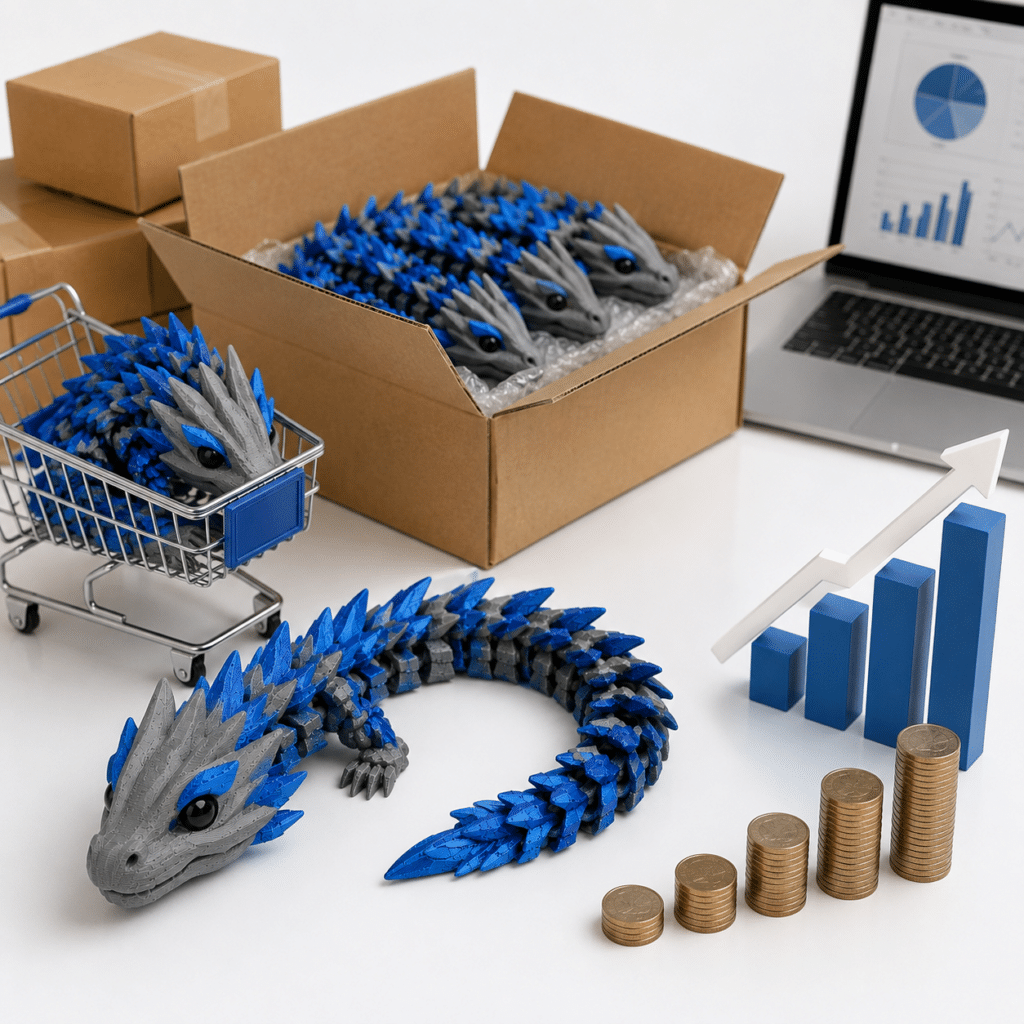
The core profitability stems from the ability to sell a dragon toy at a premium price point while keeping the cost of goods sold remarkably low. Consumers are willing to pay a premium for the mechanical “click” and fluid motion of an articulated 3d dragon, perceiving it as a high-tech novelty. Wholesale buyers can easily achieve a 300% to 500% markup on these items when positioned correctly within premium gift aisles. This exceptional return on investment makes the 3d printed dragon a cornerstone product for driving overall portfolio profitability.
Furthermore, the digital nature of the product files means that a dragon toy takes up zero physical warehouse space until it is actually needed. This “virtual inventory” model drastically reduces warehousing costs and eliminates the risk of dead stock associated with traditional seasonal gifts. A distributor can hold the digital files for an articulated 3d dragon and only trigger production when purchase orders are confirmed. This just-in-time manufacturing approach fundamentally changes the cash flow dynamics for wholesale businesses.
Ultimately, the integration of a 3d printed dragon into a B2B catalog acts as a financial hedge against supply chain disruptions. Because production does not rely on complex overseas mold factories, lead times are drastically shortened and more easily controlled. Wholesale buyers can order a dragon toy in precise, manageable batches that align perfectly with their cash flow cycles. This level of financial control and high-margin potential solidifies the articulated 3d dragon as an essential product for modern wholesale operations.
2.1. How Low Overhead Increases B2B Margins
The elimination of traditional tooling overhead is the primary catalyst for the expanded profit margins seen with an articulated 3d dragon. In conventional manufacturing, creating a new articulated toy requires tens of thousands of dollars in mold fabrication before a single unit is ever produced. Additive manufacturing completely bypasses this step, allowing a 3d printed dragon to go directly from a digital file to a physical product. This reduction in upfront overhead means the break-even point for a wholesale buyer is reached almost immediately upon the first batch sale.
This low overhead structure fundamentally changes how B2B buyers approach risk when introducing a new flexi dragon toy to their catalog. Without the pressure of recouping massive tooling investments, distributors can experiment with multiple designs, sizes, and variations simultaneously. They can order a small test batch of an articulated 3d dragon, gauge market reaction, and scale up only the winners. This iterative, low-risk purchasing model prevents the capital traps that frequently plague traditional toy wholesalers.
The savings generated by avoiding tooling costs can then be reallocated into higher-quality materials or better packaging for the 3d printed dragon. A wholesale buyer can offer a premium, retail-ready product without increasing the overall cost of goods sold. The end consumer receives a beautifully packaged dragon toy, which further justifies the premium retail price and drives higher sales volumes. This reinvestment strategy creates a cycle of increasing perceived value and expanding profit margins.
The cumulative effect of this low-overhead model is a highly agile and profitable B2B operation capable of responding to market trends in real-time. When a specific color or style of articulated 3d dragon goes viral on social media, a wholesaler is not hampered by a 6-month mold-making process. They can simply adjust the digital file and begin production of the 3d printed dragon almost instantly. This speed to market translates directly into captured sales that competitors using traditional manufacturing methods will inevitably miss.
2.2. How Scalability Meets Seasonal Demand
Meeting the unpredictable spikes of seasonal gift demand is a perennial challenge for wholesale buyers, but the production of an articulated 3d dragon offers a robust solution. During the 2025 holiday season, data showed that fidget and mechanical toy demand could spike by over 400% virtually overnight. Traditional factories struggle to accommodate these surges due to fixed machine capacities and rigid production schedules. A 3d printed dragon, however, is produced in highly scalable print farms that can be expanded or contracted based on immediate needs.
This scalability is achieved through the modular nature of additive manufacturing facilities, which can deploy hundreds of printers to work on a single flexi dragon toy order simultaneously. If a B2B buyer receives a massive, unexpected purchase order from a retail chain in November, the production capacity for an articulated 3d dragon can be instantly multiplied. There is no bottleneck of mold cooling times or assembly line retooling to slow down the fulfillment process. This elasticity ensures that wholesale buyers never miss out on crucial seasonal revenue.
The ability to scale a 3d printed dragon on demand also protects wholesalers from the post-holiday inventory crash. Overordering is a common, costly mistake in the traditional gift industry, leading to deep discounting that destroys brand value and margins. By leveraging the on-demand nature of a dragon toy, buyers can order exact quantities needed for peak weeks and then immediately scale back production in January. This precise alignment of supply and demand preserves the premium positioning of the articulated 3d dragon.
Looking toward the 2026 market insights, analysts predict that consumer purchasing patterns will become even more erratic, heavily influenced by viral social media trends. A 3d printed dragon is uniquely positioned to thrive in this environment because its production is not tied to massive, inflexible manufacturing runs. Wholesale buyers who utilize scalable additive manufacturing for their seasonal inventory will effectively insulate their businesses from both stockouts and dead stock. The flexi dragon toy represents the future of agile, season-proof wholesale sourcing.
2.3. How Customization Commands Premium Pricing
The inherent nature of additive manufacturing allows for effortless customization, which is the most powerful tool for commanding premium wholesale pricing. A standard articulated 3d dragon is an attractive product, but a customized version becomes a bespoke gift that consumers will pay significantly more to own. Wholesale buyers can leverage this by offering a 3d printed dragon in custom corporate colors, unique sizes, or with specialized finishes. This shift from a generic commodity to a tailored product instantly removes the item from price-comparison battles.
Corporate gifting represents a massive B2B vertical where a customized dragon toy can secure exceptionally high-margin contracts. Businesses are constantly searching for unique branded merchandise to give to top-tier clients and employees, moving away from generic pens and notebooks. An articulated 3d dragon printed in a company’s exact Pantone colors serves as a memorable, high-value piece of executive desk art. Wholesale distributors who pitch this customized 3d printed dragon to corporate buyers routinely secure bulk orders at triple the standard retail price point.
The process of customizing a flexi dragon toy does not carry the exorbitant setup fees associated with traditional custom manufacturing. Changing the color or scaling the size of an articulated 3d dragon requires only a few minutes of digital adjustments rather than new physical molds. This means the premium price charged to the end user is almost entirely pure profit for the wholesale buyer. The barrier to entry for offering bespoke, high-end gifts is incredibly low, making it a highly attractive strategy for B2B growth.
By marketing the customization potential of a 3d printed dragon, wholesalers can establish exclusive contracts with high-end boutique retailers who refuse to stock mass-market items. These boutiques are eager for unique inventory that their competitors cannot easily source. Providing a custom dragon toy allows the wholesaler to become a vital partner in the boutique’s branding strategy rather than just a simple vendor. This deepened B2B relationship leads to long-term, highly profitable contracts built entirely on the power of customization.
3. Which Customization Options Elevate a 3D Printed Dragon
Navigating the array of customization options for a 3d printed dragon requires a strategic understanding of what drives consumer perceived value. While the base design of an articulated 3d dragon is inherently captivating, it is the tailored modifications that transform it from a novelty into a premium gift. Wholesale buyers must carefully evaluate which customizable features will yield the highest return on investment for their specific target markets. Selecting the right modifications for a flexi dragon toy ensures that the product stands out in a crowded retail environment.
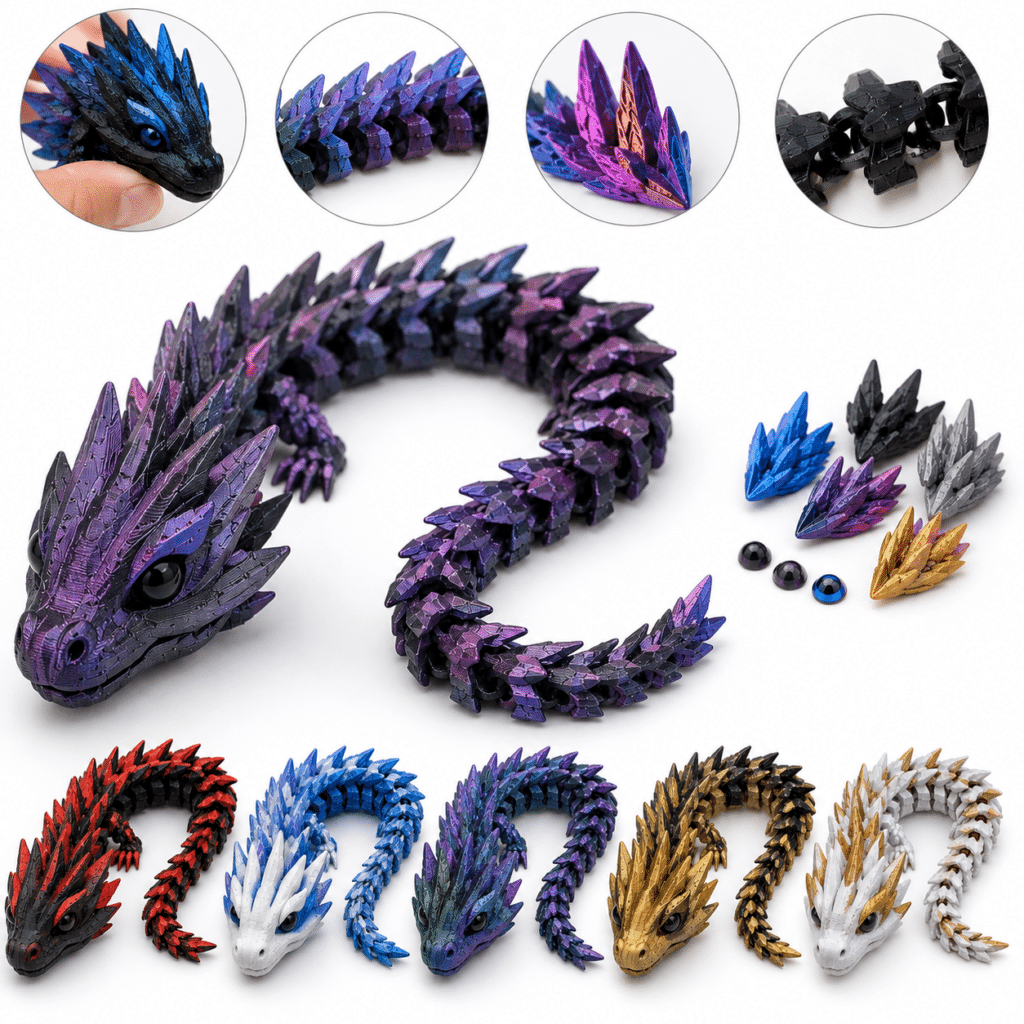
The most impactful customization options are those that enhance the tactile and visual experience of the 3d printed dragon without overly complicating the manufacturing process. Altering the filament type, adjusting the print orientation for varied flex patterns, and applying post-processing finishes are all highly effective strategies. An articulated 3d dragon that features a matte, velvety finish will feel entirely different—and more premium—than one with a standard glossy plastic sheen. These subtle touches signal high quality to the end consumer.
Furthermore, the customization strategy must align with the specific retail channel through which the dragon toy will be sold. A corporate gift catalog will require entirely different customization parameters than a museum gift shop or a comic book store. Understanding the end-user demographic allows the wholesale buyer to spec out a 3d printed dragon that perfectly matches the expectations of that specific audience. This targeted approach to customization minimizes production waste and maximizes sales velocity.
Ultimately, the goal of customizing an articulated 3d dragon is to create a product that feels bespoke and exclusive, even if it is manufactured in large wholesale quantities. By offering a curated menu of colors, sizes, and material finishes, B2B buyers empower their retail partners to curate their own unique inventory. This level of collaborative product development strengthens the wholesale relationship and elevates the 3d printed dragon from a simple commodity to a highly sought-after, customized gift item.
3.1. Which Material Blends Optimize Flexibility
Selecting the optimal material blend is the most critical technical decision when specifying a wholesale dragon toy. The articulated joints of a 3d printed dragon require a specific balance of tensile strength and elasticity to function correctly without snapping. Standard rigid plastics will fail immediately, while overly soft materials will cause the articulated 3d dragon to droop and lose its shape. Premium thermoplastic polyurethane (TPU) blends are currently the industry standard for achieving this precise mechanical balance.
A high-quality TPU filament ensures that the dragon toy can withstand thousands of bending cycles without showing signs of wear, fatigue, or joint failure. Wholesale buyers must demand strict material specifications from their manufacturing partners to ensure consistency across large production batches. An articulated 3d dragon made from inferior, brittle filaments will lead to high return rates and severe damage to the wholesaler’s reputation. Material integrity is non-negotiable when building a reliable B2B product line.
Recent advancements in 2025 have introduced hybrid PLA-TPU blends that offer a slightly stiffer hinge feel while maintaining excellent durability. This specific blend gives the 3d printed dragon a more satisfying “click” at each joint, enhancing the fidget aspect of the product. Wholesale buyers targeting the premium toy market should consider specifying these advanced material blends for their dragon toy inventory. The enhanced tactile feedback directly correlates with higher consumer satisfaction and increased word-of-mouth marketing.
Testing material samples is a crucial step that B2B buyers must take before committing to a massive production run of an articulated 3d dragon. Requesting batch-specific tensile test reports and physically manipulating the joint tension ensures the final product meets quality standards. A 3d printed dragon that feels fluid, snappy, and robust will immediately communicate premium quality to the retail buyer. Prioritizing the correct material blend is the foundation of a successful, long-lasting dragon toy product line.
3.2. Which Color Palettes Align with Brand Identities
Color customization offers one of the most lucrative avenues for elevating a 3d printed dragon into a high-value corporate or retail gift. The ability to exactly match a dragon toy to a company’s brand guidelines is a massive selling point for B2B wholesale buyers. Unlike traditional mold-injected toys that require separate pigment batches for each color, additive manufacturing can seamlessly switch colors between every single articulated 3d dragon on the print bed. This agility makes custom color matching incredibly cost-effective.
Offering a vast, on-demand color palette allows a wholesaler to pitch the 3d printed dragon as a bespoke marketing tool rather than a standard retail item. A tech company might request a matte black and neon green dragon toy to align with a specific product launch. A financial institution might prefer a subdued navy blue and silver articulated 3d dragon for their executive gift packages. This level of brand alignment transforms a simple novelty into a strategic piece of corporate identity.
The 2025 consumer data indicates that personalized color options can increase the perceived value of a desk accessory by up to 40%. When a wholesale buyer presents a catalog of 3d printed dragon options featuring customizable dual-tone or gradient color schemes, they immediately capture the attention of premium buyers. The dragon toy becomes a canvas for brand expression, allowing retailers to stock items that feel exclusive to their specific store identity. This customization prevents direct price matching by competitors.
Looking ahead to 2026, color trends in the corporate gifting space are shifting toward biodegradable, naturally dyed filaments that boast earthy, sustainable color palettes. A forward-thinking wholesale buyer can get ahead of this curve by offering an articulated 3d dragon in eco-friendly, organic colorways. By providing both vibrant brand-matched colors and sustainable material options, wholesalers can cater to every possible B2B demographic. The strategic use of color customization is an essential lever for maximizing the profitability of a 3d printed dragon.
3.3. Which Scale Variations Suit Different Retail Channels
Understanding which scale variations to offer is essential for maximizing the wholesale distribution of a flexi dragon toy across diverse retail channels. A single size does not fit all markets, making scale a critical component of the customization strategy. A massive articulated 3d dragon might be perfect for a museum gift shop display, but it is entirely impractical for an impulse-buy counter at a tech store. Wholesale buyers must curate a strategic size range to penetrate multiple B2B verticals simultaneously.
Miniature and keychain-sized variations of a 3d printed dragon are incredibly effective for high-volume, low-price-point retail environments. These tiny versions of a dragon toy serve as excellent impulse purchases at checkout counters, generating massive aggregate revenue. Despite their smaller size, the intricate articulation of a miniature articulated 3d dragon still commands a high perceived value compared to standard keychains. This makes them an easy, low-risk entry point for retailers new to additive manufactured goods.
Mid-scale versions, typically fitting within the palm of a hand, are the sweet spot for corporate gifting and standard e-commerce fulfillment. This specific size of 3d printed dragon is large enough to showcase the intricate mechanical details but small enough to ship in standard poly mailers, keeping logistics costs low. A flexi dragon toy in this mid-tier scale is ideal for inclusion in employee appreciation boxes or client welcome kits. Wholesale buyers should heavily stock this universal size to fulfill the broadest range of B2B orders.
Large, display-sized models of an articulated 3d dragon cater to a highly specialized, premium boutique market. These statement pieces are often used as centerpiece desk art or high-end collectibles, commanding top-tier price points. While the volume of sales for a large 3d printed dragon will be lower, the profit margin per unit is significantly higher. By offering a comprehensive scale range, a wholesale buyer ensures that their dragon toy catalog has a highly optimized product for every conceivable retail environment.
4. Why the Flexi Dragon Toy Outperforms Traditional Plastic Gifts
The fundamental mechanical superiority of a flexi dragon toy is what allows it to easily outperform traditional static plastic gifts in the modern market. Conventional gifts are defined by their limitations; they sit on a desk, gather dust, and offer no ongoing interactive value. An articulated 3d dragon, conversely, is defined by its kinetic energy and fluid movement. This constant interactivity keeps the product at the forefront of the user’s attention, dramatically increasing the perceived value of the 3d printed dragon over time.
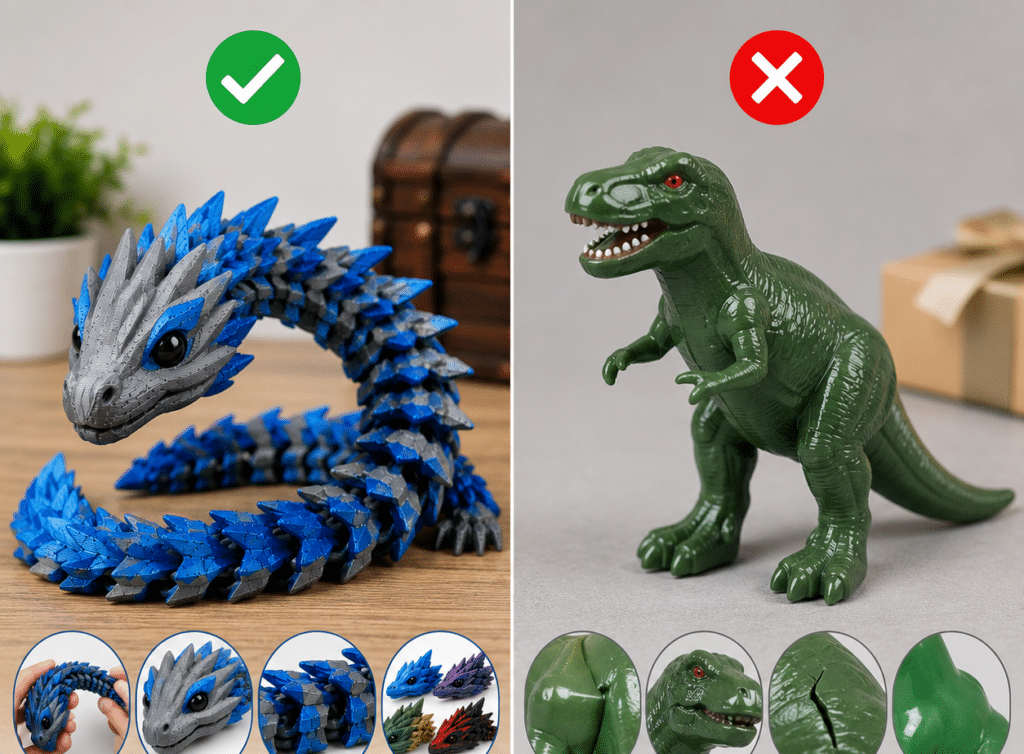
This performance gap is widening because modern consumers, particularly Gen Z and Millennials, actively seek out items that provide tactile stress relief and sensory engagement. A dragon toy serves a dual purpose as both an aesthetically pleasing piece of art and a highly functional fidget mechanism. The satisfying “click” and smooth articulation of an articulated 3d dragon provide a micro-dose of stress relief during the workday. Traditional plastic gifts simply cannot compete with this level of functional, ongoing utility.
The durability of a 3d printed dragon also heavily contributes to its superiority over brittle, injection-molded alternatives. Traditional articulated toys often rely on small, metal pins or fragile plastic clips that break within days of use. A dragon toy utilizes interlocking, print-in-place joints that possess inherent flexibility and structural resilience. This means an articulated 3d dragon can be twisted, bent, and compressed repeatedly without suffering catastrophic mechanical failure, ensuring a long lifespan for the product.
From a B2B perspective, stocking a 3d printed dragon significantly reduces the rate of customer returns and warranty claims compared to traditional complex toys. The simplified, single-material construction of a dragon toy means there are no small parts to detach and no weak glue joints to fail. Wholesale buyers can confidently sell an articulated 3d dragon knowing that the product will consistently deliver a premium, durable experience. This reliability protects the wholesaler’s brand reputation and fosters long-term trust with retail partners.
5. How to Source Articulated 3D Dragons for Wholesale Success
Sourcing a high-quality articulated 3d dragon requires a fundamentally different approach than traditional overseas toy procurement. B2B buyers cannot simply browse a catalog of pre-existing steel molds; they must partner with specialized additive manufacturing facilities. Finding the right production partner for a 3d printed dragon is the single most important step in building a successful wholesale program. The supplier’s technical capabilities will directly dictate the quality, consistency, and profitability of the dragon toy.
The vetting process for an additive manufacturing partner must focus heavily on their capacity for high-volume, consistent production. Printing a single articulated 3d dragon on a hobbyist machine is vastly different from producing ten thousand units with uniform tension and flawless surface finish. Wholesale buyers must audit the facility’s print farm, ensuring they use industrial-grade equipment capable of running 24/7. A reliable supplier for a 3d printed dragon will have stringent quality control protocols at every stage of the production process.
Communication and digital file management are also critical components of successfully sourcing a flexi toy. The wholesale buyer and the manufacturer must collaborate closely on optimizing the digital files for both print speed and structural integrity. Slight adjustments to the print orientation or infill density of an articulated 3d dragon can drastically reduce production time without compromising the final product. This collaborative engineering phase is essential for achieving the lowest possible cost of goods sold.
Establishing a strong, long-term relationship with a specialized manufacturer unlocks the true potential of selling a 3d printed dragon. As the wholesale buyer’s sales volume grows, the manufacturer can offer tiered pricing, priority production slots during peak seasons, and early access to new design iterations. A dependable supply chain for a flexi toy transforms a simple product import into a scalable, highly profitable B2B enterprise. Prioritizing supplier relationships is the key to sustained wholesale success.
5.1. How to Evaluate Supplier Production Capacity
Evaluating the raw production capacity of a potential supplier is the first critical hurdle when sourcing an articulated 3d dragon. A facility may boast an impressive array of machines, but if their throughput is bottlenecked by slow print speeds or excessive manual post-processing, they will fail to meet wholesale deadlines. B2B buyers must request detailed production metrics, specifically focusing on how many hours it takes to produce a single 3d printed dragon from start to finish. This data provides a baseline for calculating whether the supplier can handle large purchase orders.
The physical footprint of the print farm directly correlates with the supplier’s ability to scale an order of a flexi toy. A true industrial additive manufacturing partner will have hundreds, if not thousands, of synchronized print heads running concurrently. This massive parallel processing capability ensures that an articulated 3d dragon can be produced in bulk quantities without long lead times. Wholesale buyers should be highly skeptical of suppliers who rely on a small handful of large-format printers, as these are prone to catastrophic failures that can wipe out entire production batches.
Labor capacity is another crucial, often overlooked metric when vetting a supplier for a 3d printed dragon. While the printing process is automated, the removal of support structures, washing, curing, and packaging of a flexi dragon toy require significant manual labor. A supplier might have enough printers, but if they lack the staff to process the output, the order will stall. B2B buyers must ensure the supplier’s labor force scales appropriately with their machine capacity to guarantee smooth, continuous fulfillment of every articulated 3d dragon.
Ultimately, evaluating production capacity requires requesting a trial run of a 3d printed dragon before committing to a massive contract. This trial run exposes the supplier’s true capabilities regarding consistency, turnaround time, and communication. If the supplier delivers a flawless batch of the flexi toy on time and within spec, they have proven their capacity. This empirical evidence is far more valuable than any marketing brochure or facility tour when selecting a wholesale manufacturing partner.
5.2. How to Negotiate Custom Batch Agreements
Negotiating custom batch agreements for an articulated 3d dragon requires a deep understanding of additive manufacturing economics. Unlike traditional manufacturing where the bulk of the cost is in the mold, the cost of a 3d printed dragon is entirely in the machine time and material. B2B buyers should negotiate pricing tiers based on cumulative volume over a 12-month period rather than single, massive upfront orders. This structure allows the wholesaler to secure bulk pricing on a flexi toy without tying up excessive capital in inventory.
A highly effective negotiation strategy is to offer the manufacturer exclusivity guarantees in exchange for lower per-unit costs on an articulated 3d dragon. If a wholesale buyer commits to purchasing all of their 3d printed dragon inventory from a single facility, the supplier can confidently optimize their machines specifically for that file. This operational efficiency allows the manufacturer to pass significant savings back to the buyer. The resulting custom batch agreement creates a mutually beneficial partnership that drives down the cost of every flexi toy produced.
Payment terms within these custom agreements should also be structured to reflect the reduced financial risk of additive manufacturing. Because there are no tooling investments to amortize, B2B buyers can negotiate favorable terms such as net-60 or net-90 payment windows for an articulated 3d dragon. This allows the wholesale buyer to receive, distribute, and generate revenue from the 3d printed dragon before the invoice is due. Strategic cash flow management through favorable payment terms is a hallmark of sophisticated B2B negotiation.
Finally, the custom batch agreement must include strict quality assurance clauses specific to the mechanical function of a flexi toy. The contract should clearly define acceptable tolerances for joint tension, print layer adhesion, and surface finishing. If a batch of articulated 3d dragons arrives with brittle joints or sloppy tolerances, the agreement must mandate immediate replacement at the supplier’s expense. These protective clauses ensure that the wholesale buyer’s reputation is shielded from manufacturing inconsistencies.
5.3. How to Integrate These Items into Existing Catalogs
Integrating an articulated 3d dragon into an existing wholesale catalog requires strategic merchandising to avoid it being lost among standard inventory. The 3d printed dragon should not be categorized as a standard children’s toy, as this diminishes its premium perceived value. Instead, the flexi toy should be positioned prominently within high-end gift sets, executive desk accessories, or specialty fidget categories. This intentional placement immediately signals to retail buyers that this is a high-margin, premium product.
Visual merchandising assets provided by the wholesale buyer must showcase the kinetic nature of the articulated 3d dragon. Static catalog images fail to communicate the primary selling point of the product. B2B buyers need to supply their retail partners with high-definition video content and GIFs demonstrating the smooth, satisfying flex of the 3d printed dragon. Providing these dynamic marketing assets makes it incredibly easy for retailers to sell the flexi toy on their e-commerce platforms and social media channels.
Cross-merchandising strategies can also drive massive incremental sales for a 3d printed dragon. Wholesale buyers should suggest that their retail partners display the articulated 3d dragon alongside complementary items such as premium puzzles, high-end notebooks, or artisanal desk organizers. By placing a flexi toy in the line of sight of a consumer purchasing other premium gift items, the capture rate increases exponentially. This strategic integration turns a novelty item into a core driver of basket size.
Training the wholesale sales team on the unique value proposition of additive manufacturing is the final step in successful catalog integration. The sales team must be able to articulate why a 3d printed dragon commands a higher price point than a standard plastic toy. They must understand the customization options, the material science behind the joints, and the sustainability aspects of the flexi dragon toy. An educated sales force is the most effective tool for driving widespread B2B adoption of an articulated 3d dragon.
6. Why 2026 Market Insights Point to Sustained 3D Print Growth
Leading industry forecasts for 2026 indicate that the integration of additive manufacturing into the mainstream gift and novelty sector will accelerate at an unprecedented rate. Market research firms project that the demand for mechanically complex, on-demand manufactured items will outpace traditional toy manufacturing by a significant margin. The 3d printed dragon is perfectly positioned to capture a massive share of this expanding market. Wholesale buyers who establish their supply chains now will be the primary beneficiaries of this sustained 2026 growth.
This sustained growth is being driven by a permanent shift in consumer psychology regarding the environmental impact of their purchases. By 2026, it is projected that over 60% of consumers will actively seek out products made via on-demand manufacturing to reduce industrial waste. A 3d printed dragon aligns perfectly with this ethos, as it is created using only the exact amount of material needed, with zero mold waste. The eco-friendly production method of an articulated 3d dragon serves as a powerful marketing tool for environmentally conscious retailers.
The advancement of high-speed, industrial-grade 3D printing technology will also make a flexi dragon toy even more profitable in 2026. As print speeds double and material costs decrease, the margin potential for a 3d printed dragon will expand significantly. Wholesale buyers will be able to offer aggressive retail pricing while maintaining or even improving their own profit margins. This technological deflation ensures that an articulated 3d dragon will transition from a premium novelty into a mainstream retail staple.
The B2B buyers who recognize these 2026 market insights and act decisively will build an unassailable competitive moat. By securing exclusive customization rights and preferred pricing for a flexi dragon toy now, they lock out future competitors. The 3d printed dragon is not a passing fad, but rather the vanguard of a fundamental shift in how novelty gifts are designed, produced, and sold. Forward-thinking wholesalers are aggressively building their 2026 strategies around this highly customizable, highly profitable product category.
Conclusion
The strategic advantages of incorporating a 3d printed dragon into a wholesale portfolio are overwhelming and backed by clear market trends. From the elimination of tooling overhead to the immense power of bespoke customization, the flexi dragon toy represents a paradigm shift in B2B product sourcing. The articulated 3d dragon consistently outperforms traditional static plastics by offering superior tactile engagement, remarkable durability, and highly scalable production. By aligning procurement strategies with the 2025 data and 2026 market projections, wholesale buyers can secure a highly profitable, future-proof revenue stream.
To capitalize on this rapidly expanding market, businesses must move away from outdated manufacturing models and embrace the agility of additive manufacturing. Whether targeting corporate gifting verticals, premium boutique retail, or high-volume e-commerce, the 3d printed dragon offers a versatile and highly customizable solution. Now is the critical time to audit your product catalog, identify the gaps in your interactive gift offerings, and connect with a specialized manufacturing partner.
Contact our B2B sales team today to request your wholesale sample kit and discover how a customized flexi dragon toy can elevate your brand’s profitability. Let us help you design a bespoke articulated 3d dragon that perfectly aligns with your retail channel’s specific demographic and pricing requirements. Secure your competitive advantage and prepare your inventory for the future of the gift market by integrating these premium, high-margin products today.
Frequently Asked Questions
1. What is the typical minimum order quantity (MOQ) for a wholesale 3D printed dragon order?
Because additive manufacturing requires no physical tooling or mold fabrication, the MOQ for a 3d printed dragon is significantly lower than traditional injection-molded toys. B2B buyers can typically start with a test batch of 50 to 100 units to gauge market reception. This low-risk entry point allows wholesalers to test different variations of an articulated 3d dragon before committing to larger, high-volume seasonal orders.
2. How can a flexi dragon toy be customized to match specific corporate brand identities?
Additive manufacturing allows for seamless color switching without the need for separate pigment batches or mold changes. A 3d printed dragon can be produced in exact Pantone colors to align perfectly with corporate branding guidelines. Furthermore, wholesale buyers can request dual-tone or gradient color schemes, transforming a standard articulated 3d dragon into a bespoke piece of executive marketing merchandise.
3. Which materials are used to ensure the durability of an articulated 3D dragon in a retail environment?
Premium thermoplastic polyurethane (TPU) is the industry standard for producing a highly durable flexi dragon toy. This specific material blend provides the perfect balance of tensile strength and elasticity, allowing the print-in-place joints to withstand thousands of bending cycles. Advanced hybrid PLA-TPU blends are also utilized to give the 3d printed dragon a satisfying, premium tactile “click” at each joint without compromising structural integrity.
4. What kind of profit margins can B2B buyers expect when adding a 3D printed dragon to their catalog?
The complete elimination of upfront tooling costs allows wholesale buyers to achieve exceptionally high markups, often ranging from 300% to 500%. Because the consumer perceives the intricate mechanics of an articulated 3d dragon as a high-tech novelty, they are willing to pay a premium retail price. The low cost of goods sold associated with a flexi dragon toy translates directly into expanded profit margins for distributors.
5. How are wholesale orders of a flexi dragon toy packaged and shipped to minimize logistics costs?
A 3d printed dragon is highly space-efficient compared to traditional boxed toys, allowing B2B buyers to optimize their freight and warehousing expenses. Mid-scale versions are designed to fit efficiently into standard poly mailers for direct-to-consumer e-commerce fulfillment. Wholesale suppliers typically offer custom retail-ready packaging options that protect the articulated 3d dragon while minimizing dimensional weight.
6. Why do 2026 market insights suggest that investing in a 3D printed dragon is a sustainable long-term strategy?
Industry forecasts project that by 2026, over 60% of consumers will actively seek out on-demand manufactured goods to reduce industrial waste. A flexi dragon toy is produced using only the exact amount of material required, creating zero mold waste. Aligning a wholesale catalog with an articulated 3d dragon positions B2B buyers to capture the rapidly growing segment of environmentally conscious consumers and corporate buyers.
7. How quickly can a manufacturer scale production of an articulated 3D dragon to meet seasonal demand spikes?
Modular print farms can instantly multiply production capacity by deploying hundreds of machines to work on a single 3d printed dragon order simultaneously. Unlike traditional factories bottlenecked by mold cooling times, a flexi dragon toy can be scaled up or down in real-time. This elasticity ensures that wholesale buyers can meet unpredictable 2025 holiday surges without facing stockouts or post-season dead stock.
8. Which retail channels are the most profitable for distributing a customized 3D printed dragon?
Corporate gifting catalogs represent the highest-margin vertical, as businesses pay premium prices for branded, functional desk accessories. A flexi dragon toy also performs exceptionally well in premium boutique shops, museum gift stores, and high-end e-commerce platforms. By offering different scale variations of an articulated 3d dragon, wholesalers can successfully penetrate multiple diverse retail environments from a single digital file.
9. How do manufacturers maintain quality control consistency across large batches of a flexi dragon toy?
Reputable additive manufacturing facilities implement stringent quality control protocols at every stage of the production process. For an articulated 3d dragon, this includes monitoring print bed temperatures, ensuring precise filament extrusion, and physically testing the joint tension of sample units. Wholesale buyers should always negotiate custom batch agreements that mandate specific tolerance limits for their 3d printed dragon inventory to prevent high return rates.
10. How does holding a flexi dragon toy as “virtual inventory” benefit a wholesale buyer’s cash flow?
Virtual inventory means the B2B buyer holds the digital production files rather than thousands of physical units sitting in a warehouse. A 3d printed dragon is only manufactured after a firm purchase order is confirmed, completely eliminating warehousing costs and the risk of dead stock. This just-in-time production model for an articulated 3d dragon drastically improves cash flow dynamics and reduces overall financial risk.