

1. Why Dragon 3D Print Models Are Dominating the 2025 Collectibles Market
The global 3D printing industry reached a valuation of $24.9 billion in 2025, with fantasy collectibles emerging as a surprisingly dominant revenue driver. Within this sector, demand for dragon 3d print collectibles has surged exponentially, moving from a niche hobbyist pursuit to a mainstream retail staple. This explosive growth is largely fueled by advancements in high-speed resin and FDM printing technologies, which now allow manufacturers to produce massive volumes of highly detailed miniatures at a fraction of traditional tooling costs. B2B buyers are taking note, as the barrier to entry for stocking premium fantasy collectibles has effectively been eliminated.
The driving force behind this trend is the fundamental shift in consumer entertainment consumption, heavily influenced by blockbuster fantasy media and tabletop gaming communities. Collectors no longer want generic, mass-produced plastic toys. They seek intricate, museum-quality pieces that tell a story. A carefully crafted dragon 3d print fulfills this desire perfectly, offering unparalleled mythological detail that resonates deeply with dedicated fanbases. This cultural shift mandates that retailers and distributors adapt their inventory strategies to meet the rising standard of digital-first manufacturing.
This market evolution directly affects wholesale buyers by completely restructuring inventory risk. Traditional manufacturing required massive minimum order quantities (MOQs) and upfront tooling investments, tying up capital for months. By pivoting to a supply chain based on 3d printed dragons, B2B buyers can order in highly targeted micro-batches. This agility allows distributors to test multiple dragon designs in different regional markets simultaneously, identifying top sellers without the financial peril of overstocking unpopular static inventory.
The most strategic response for businesses is to partner with specialized wholesale manufacturers who offer robust customization pipelines. Securing a reliable source for customized dragon 3d print models ensures that a brand’s inventory remains exclusive and protected from race-to-the-bottom pricing wars. Businesses that embrace this digital manufacturing model today will secure a distinct competitive advantage, capturing both the enthusiast collector market and the high-margin premium gift sector.
1.1 How Wholesale Buyers Can Capitalize on This Trend
Wholesale buyers can immediately capitalize on this movement by diversifying their product catalogs with tiered pricing models based on print resolution and material quality. Offering an entry-level PLA dragon 3d print alongside a premium, hand-finished resin version allows retailers to capture multiple consumer demographics. Furthermore, distributors who bundle these figures with complementary products—such as tabletop terrain or custom display bases—can significantly increase their average order value and drive higher retail foot traffic.
1.2 Which Dragon 3D Print Niches Offer the Highest Margins
The highest profit margins in 2025 are found within the premium tabletop gaming and luxury desktop accessory niches. Highly stylized, asymmetric dragons designed specifically as dice towers or encrypted storage boxes command retail prices four to five times their production cost. Customization in these specific niches, such as integrating a company’s branding into the sculpted base of the 3d printed dragons, transforms a simple collectible into a high-value corporate gift item with exceptionally padded profit margins.
1.3 How Customization Drives Bulk Order Value
Customization is the ultimate lever for increasing bulk order value in the modern collectibles space. When B2B clients realize they can request specific poses, altered scales, or custom metallic filament finishes for their dragon 3d print orders, their perceived value of the product skyrockets. Manufacturers who offer intuitive customization menus for their 3d printed dragons empower wholesale buyers to create bespoke product lines, effectively locking out competitors and justifying premium wholesale pricing structures.
2. How 3D Printed Dragons Enhance B2B Retail Offerings
Integrating 3d printed dragons into a B2B retail ecosystem fundamentally transforms the visual merchandising potential of a store or e-commerce platform. Unlike traditional boxed collectibles that remain hidden until purchased, a masterfully produced dragon 3d print serves as an immediate visual anchor. The sheer geometric complexity and striking silhouettes of these models naturally draw the consumer’s eye, creating a halo effect that boosts the sales performance of adjacent, less visually striking products. Retailers leveraging this aesthetic pull are seeing measurable increases in overall basket size.

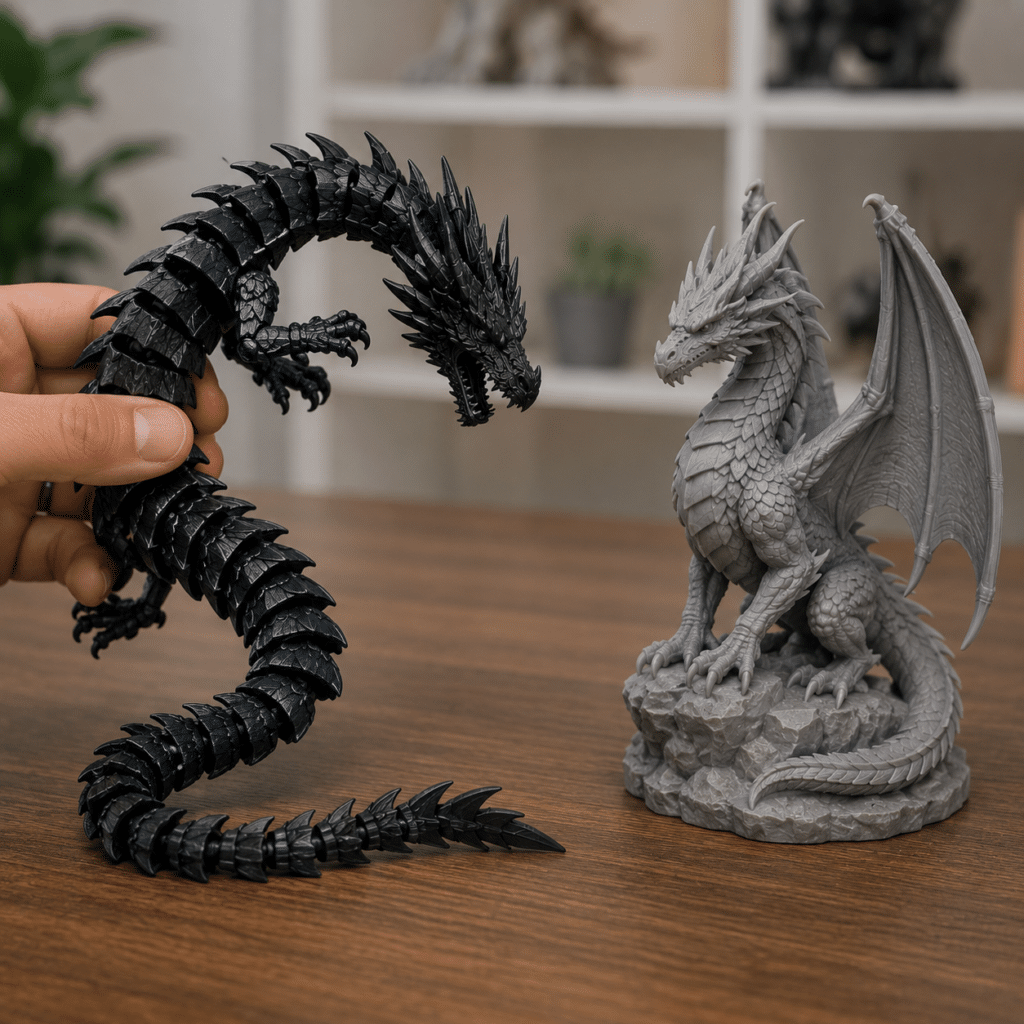
The introduction of the articulated dragon has completely revolutionized how these products perform on physical and digital shelves. An articulated dragon features a sophisticated network of interlocking, print-in-place joints that allow the figure to flex, pose, and move organically. This mechanical interactivity transforms a passive display piece into an engaging tactile experience. Retail data from early 2025 indicates that interactive collectibles experience a 35% higher engagement rate at point-of-sale compared to static figures, directly translating to stronger conversion metrics.
For the wholesale buyer, stocking an articulated dragon provides a distinct narrative advantage for marketing and sales teams. The movement of the model offers incredible viral marketing potential on social media platforms like TikTok and Instagram, where unboxing and “flexing” videos generate millions of organic impressions. When B2B distributors provide their retail partners with an articulated dragon that practically markets itself through user-generated content, they are delivering a highly sellable asset rather than just a physical product.
To fully leverage this, businesses must ensure their 3d printed dragons are manufactured with exacting tolerances. A beautifully sculpted but overly stiff or fragile articulated dragon will result in immediate returns and damaged retail relationships. B2B buyers must rigorously vet their manufacturing partners to guarantee that the friction-fit joints are printed with precise calibration, ensuring a smooth, satisfying movement that withstands repeated handling by end consumers.
2.1 Why an Articulated Dragon Model Outperforms Static Figures
An articulated dragon consistently outperforms static figures because it satisfies the modern consumer’s desire for dual-purpose products. It acts as both a high-end collectible display and an interactive fidget device or tabletop gaming prop. This dual utility ensures the product remains out of the box and on the consumer’s desk or gaming table, maximizing brand visibility and reducing the likelihood of the product being stored away and forgotten.
2.2 How to Source High-Quality 3D Printed Dragons for Resale
Sourcing high-quality 3d printed dragons requires B2B buyers to move beyond consumer-grade printing farms and partner with industrial-scale additive manufacturing facilities. Key sourcing criteria include evaluating the manufacturer’s post-processing capabilities, such as vapor smoothing for resin prints to eliminate layer lines, and their quality control protocols for color consistency across large batches. Establishing a relationship with a factory that understands the rigorous demands of retail packaging and shipping logistics is essential for long-term success.
2.3 Which Customization Options Attract High-End Collectors
High-end collectors are primarily attracted to bespoke finishing options that elevate a standard dragon 3d print into a bespoke work of art. Options such as multi-color filament transitions, hand-painted washes that highlight intricate scale details, and the integration of embedded LED lighting systems are highly sought after. By offering these premium customization tiers, B2B sellers can effectively target the luxury collector demographic, which is largely immune to standard retail price sensitivity.
3. Which Dragon 3D Print Designs Will Define 2026 Market Projections
Industry projections for 2026 indicate that the fantasy collectible sector will experience a 22% increase in demand for highly customized, modular figures. The era of the monolithic, single-pour dragon 3d print is giving way to modular ecosystems. Future designs will feature detachable wings, swapable heads, and interchangeable armor pieces, allowing collectors to personalize their displays over time. B2B buyers who align their 2026 wholesale strategies with this modular trend will capture a market that is actively rejecting disposable, single-use collectibles in favor of evolving, long-term investments.
This impending shift is happening because the consumer baseline for 3d printed dragons has matured. As the technology becomes ubiquitous, mere geometric complexity is no longer a sufficient selling point. Collectors in 2026 will demand engineering innovation. They want models that showcase the absolute limits of what additive manufacturing can achieve, such as models combining rigid structural bones with flexible, TPU-based membrane wings in a single, seamless assembly. This technological leap requires wholesale buyers to seek out advanced manufacturing partners who possess multi-material printing capabilities.
The impact on B2B inventory management will be profound, requiring a transition from physical stock to digital inventory models. Forward-thinking distributors will begin licensing or purchasing high-quality digital files, utilizing a hybrid print-on-demand and bulk-preorder system. By holding the digital assets for a customizable dragon 3d print, businesses can offer infinite variations without tying up capital in physical warehouse space. This drastically reduces overhead costs while simultaneously offering the consumer an unprecedented level of bespoke product configuration.
To prepare for this shift, businesses must begin restructuring their vendor relationships immediately. Relying on overseas container shipments of pre-made, static 3d printed dragons will become a liability in 2026. The strategic response is to invest in domestic or highly agile nearshore additive manufacturing partners who can execute complex, multi-part orders rapidly. Building a supply chain capable of producing a highly articulated dragon with modular accessories on demand is the only way to remain competitive in the coming digital-first retail landscape.
3.1 How Anticipated 2026 Trends Will Shape Wholesale Inventories
Anticipated 2026 trends will force wholesale inventories to become significantly leaner and more agile. Distributors will shift away from stocking thousands of identical units, instead holding smaller core inventories of modular base models. The remaining inventory space will be dedicated to raw printing materials and finishing supplies, allowing businesses to customize and finalize a dragon 3d print at the very last moment based on real-time retail demand data.
3.2 Why Multi-Material 3D Printed Dragons Are the Future
Multi-material 3d printed dragons represent the inevitable future of the industry because they solve the historic limitations of additive manufacturing. By combining rigid PLA or Resin for the main body with flexible TPU for the joints and wing membranes, manufacturers can create an incredibly durable and realistic articulated dragon. This hybrid material approach eliminates the fragile, snapping joints that have historically plagued print-in-place models, ensuring a premium, long-lasting product.
3.3 How to Future-Proof Your Custom Dragon 3D Print Catalog
Future-proofing a custom dragon 3d print catalog requires a strict commitment to digital asset management and scalable manufacturing architecture. B2B buyers should ensure that every new design they commission or license is digitally optimized for both high-detail resin printing and high-volume FDM production. Maintaining a versatile library of digital files guarantees that as consumer tastes shift toward different dragon sub-species or aesthetic styles, the business can pivot its production instantly without incurring new design fees.
4. How to Partner with Manufacturers for Custom Dragon 3D Print Success
Securing the right manufacturing partnership is the single most critical factor in achieving long-term profitability with a dragon 3d print product line. The transition from concept to a market-ready articulated dragon requires a factory that understands both the artistic nuances of fantasy sculpting and the rigorous, repeatable demands of B2B wholesale fulfillment. A true manufacturing partner does not merely act as a printing service; they act as a strategic advisor, guiding B2B buyers through material selection, structural engineering, and cost-optimization strategies. Establishing this foundational relationship early prevents costly downstream failures.
The necessity for rigorous vetting stems from the fact that printing a high-quality articulated dragon at scale is an engineering challenge. Print-in-place joints require perfectly calibrated tolerances; a variance of just a fraction of a millimeter can result in a batch of 3d printed dragons that are either permanently frozen or too loose to hold a pose. B2B buyers must demand comprehensive sampling protocols, requiring manufacturers to provide unedited, straight-off-the-printer samples to verify that the tolerances hold up across different ambient temperatures and production lines.
An ideal wholesale partnership operates on a framework of transparent communication and scalable customization. The best manufacturers provide B2B clients with access to a dedicated project manager, real-time production tracking, and clear timelines for custom dragon 3d print runs. They will also offer tiered finishing options, ranging from raw, unpainted bulk shipments for budget-conscious retailers to fully painted, retail-ready units for luxury boutiques. This flexibility allows a wholesale buyer to serve multiple distinct market segments under a single, reliable supply chain umbrella.
Businesses ready to dominate the fantasy collectible market must take decisive action to secure these specialized manufacturing partnerships today. The window to establish a unique foothold with bespoke 3d printed dragons is narrowing as the market becomes increasingly saturated with low-quality imports. By reaching out to premium wholesale 3D printing experts to discuss custom design capabilities, material innovations, and bulk pricing structures, B2B buyers can position themselves at the forefront of this lucrative industry evolution.
4.1 Why Vetting Production Capabilities Prevents Costly Errors
Vetting production capabilities thoroughly prevents disastrous financial errors, particularly when dealing with complex mechanical models. A manufacturer might produce a beautiful static prototype but lack the calibrated machinery to consistently replicate an articulated dragon across ten thousand units. Rigorous testing of a factory’s batch consistency ensures that wholesale buyers do not end up with a warehouse full of defective 3d printed dragons that cannot be sold or returned.
4.2 How to Initiate Your First Custom Wholesale Order
Initiating a first custom wholesale order requires a structured approach that begins with a comprehensive design brief. B2B buyers should provide their manufacturing partner with exact specifications regarding the intended use of the dragon 3d print, the target retail price point, and the desired level of detail. Starting with a small, controlled test batch of 50 to 100 units allows the buyer to assess market reaction and production quality before committing to a massive container-level order.
4.3 Which Next Steps Will Secure Your Market Position
The definitive next step to secure your market position is to establish an exclusive manufacturing agreement for a bespoke line of 3d printed dragons. Contacting a specialized B2B 3D printing manufacturer today to review digital sculpt portfolios, request material samples, and outline a customized production roadmap will insulate your business from future market volatility. Taking this proactive step guarantees that your inventory will remain unique, highly profitable, and perfectly aligned with the advanced expectations of the 2026 collector market.
Frequently Asked Questions
1. How Low Can Minimum Order Quantities Go for Bulk Orders
Minimum order quantities for a dragon 3d print are significantly lower than traditional injection molding, often starting between 50 and 100 units. This micro-batch capability allows B2B buyers to test multiple variations of 3d printed dragons without tying up substantial capital in physical inventory. Wholesale suppliers utilizing industrial additive manufacturing can easily scale these initial test batches into thousands of units once a specific design proves successful in the retail market.
2. Which Customization Options Are Available for Wholesale Buyers
Wholesale buyers have access to extensive customization pipelines, ranging from multi-color filament choices to bespoke structural modifications. A business can request a customized dragon 3d print featuring branded bases, altered poses, or unique scale patterns tailored to their specific retail demographic. High-tier manufacturers also offer premium finishing options like hand-painted washes and vapor smoothing to elevate the perceived value of the 3d printed dragons.
3. How Durable Is an Articulated Dragon for Retail Environments
The durability of an articulated dragon depends entirely on the precision of the manufacturer’s print calibration and material selection. When produced by a reputable wholesale partner using high-quality PLA or specially formulated resins, the friction-fit joints are engineered to withstand hundreds of flexing cycles without snapping. B2B buyers must always request unedited production samples to verify that the joint tolerances are tight enough to hold poses but loose enough to prevent breakage during consumer handling.
4. Why Material Selection Matters for 3D Printed Dragons
Material selection dictates both the aesthetic finish and the structural integrity of a dragon 3d print. Standard PLA offers a balance of cost-efficiency and vibrant color options, making it ideal for high-volume, budget-conscious retail. Conversely, premium resins or multi-material setups combining rigid plastics with flexible TPU are necessary for an articulated dragon that requires bendable wing membranes and supreme, microscopic detail.
5. Which 2026 Design Trends Should Dictate Current Inventory Choices
Current inventory choices should heavily prioritize modular and multi-material designs to align with 2026 market projections. Consumers are rapidly moving away from static, single-pour models in favor of 3d printed dragons that feature detachable accessories and swapable components. B2B buyers who secure digital files and manufacturing partners capable of producing these modular ecosystems now will be perfectly positioned to meet the upcoming demand for highly customizable, evolving collectibles.
6. How Wholesale 3D Printed Dragons Are Packaged for Safe Shipping
Proper packaging for 3d printed dragons requires specialized internal support structures, particularly for fragile or complex models. A professional manufacturer will utilize custom-fit foam inserts or engineered cardboard suspensions to prevent the delicate spikes or appendages of a dragon 3d print from snapping during transit. For an articulated dragon, packaging must also restrict excessive movement to ensure the friction-fit joints do not warp under pressure inside the shipping carton.
7. Why Profit Margins Remain High for Custom Fantasy Collectibles
Profit margins remain exceptionally high because additive manufacturing eliminates the exorbitant upfront costs associated with steel mold tooling. By removing this barrier, the cost-per-unit for a customized dragon 3d print stays relatively flat regardless of the geometric complexity of the sculpt. B2B buyers can therefore command premium retail prices for intricate 3d printed dragons while maintaining a highly favorable markup percentage on their wholesale investment.
8. How Fast Can a Bulk Dragon 3D Print Order Be Fulfilled
Fulfillment times for bulk orders have drastically improved with the advent of high-speed industrial print farms. A standard wholesale order of several hundred 3d printed dragons can typically be completed, post-processed, and packaged within two to three weeks. Expedited production runs are also available from top-tier manufacturers, allowing B2B buyers to quickly restock a viral articulated dragon model before consumer demand peaks and fades.
9. Which Sourcing Strategies Work Best for Unique Dragon Designs
The most effective sourcing strategy involves partnering directly with additive manufacturing facilities that employ in-house digital sculptors or hold commercial licensing rights to popular 3D model libraries. This approach ensures B2B buyers receive legally protected, commercially viable files for their dragon 3d print inventory. Sourcing from unauthorized or hobbyist pools carries significant intellectual property risks that can result in severe financial penalties for wholesale distributors.
10. How Retailers Can Transition from Traditional to 3D Printed Inventory
Retailers should initiate the transition by introducing a small, highly curated selection of premium 3d printed dragons alongside their existing traditional inventory to gauge consumer response. Displaying an interactive articulated dragon at point-of-sale acts as an immediate traffic driver, helping to shift consumer expectations. As traditional plastic inventory depletes, B2B buyers can seamlessly replace those SKUs with a wider array of customized, higher-margin 3D printed alternatives.